How Flooring Wear Layers Fail: Abrasion, Delamination and Moisture
How flooring wear layers fail is progressive surface abrasion plus interfacial bond breakdown: the thin protective topcoat erodes under mechanical stress, UV, and moisture gradients until the decorative film or wood veneer below is exposed, clouded, dented, or peels away. A wear layer, put simply, is the sacrificial clear coat engineered to take the beating so the pretty part doesn’t—and once it is gone, the floor’s service life is effectively over even if the core is still intact.
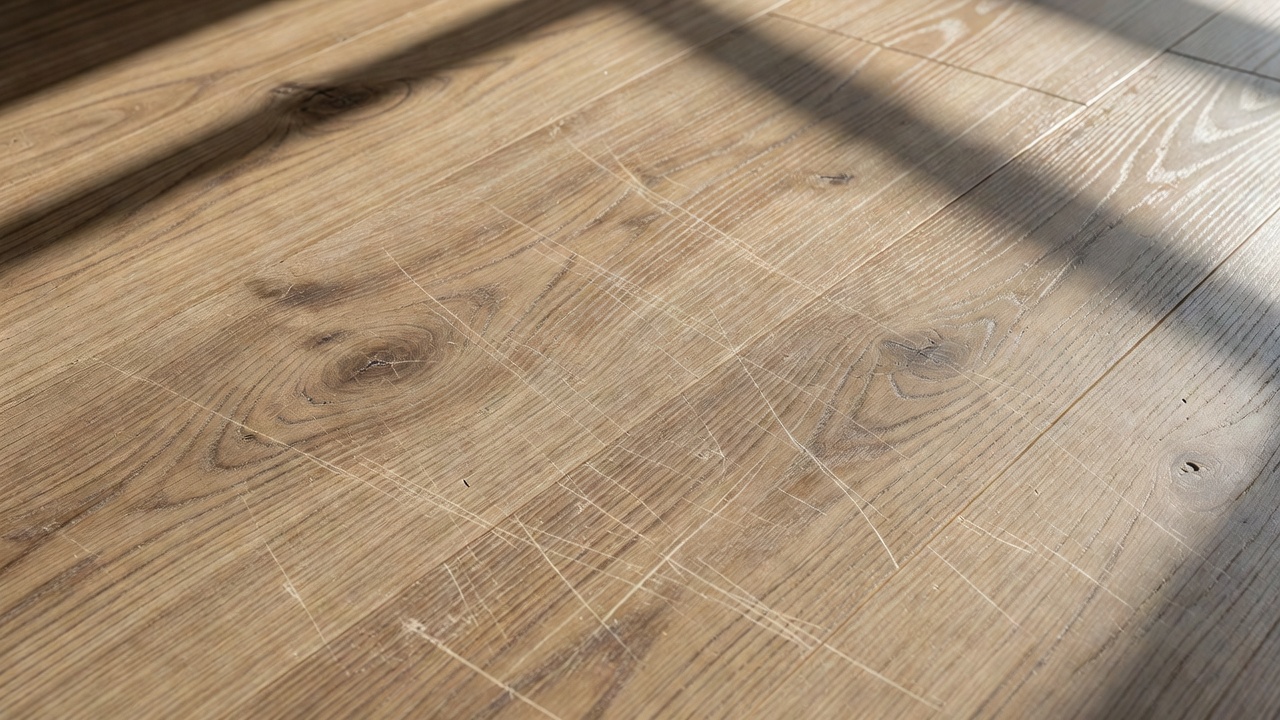
That microscopic story becomes easier to diagnose once you separate abrasion, impact, bond loss and moisture movement. A thickness chart cannot explain those different failure modes by itself.
How thick should a wear layer be for residential use?
Thickness states how much wear-layer material is present before the décor layer, but it does not state the coating’s abrasion resistance. In vinyl plank, wear layers are commonly reported in mils (one mil is one-thousandth of an inch). Compare products only when the coating, declared test method, intended use and warranty are also known.
For engineered hardwood, the available wood above the tongue or core limits what a refinisher can remove; construction varies too much for a universal sanding count. Laminate uses an overlay and classification system rather than a sandable wood veneer. Verify the construction and manufacturer guidance for the exact product.
For the closest related guidance, see vinyl wear-layer thickness science.
What causes delamination in vinyl plank flooring?
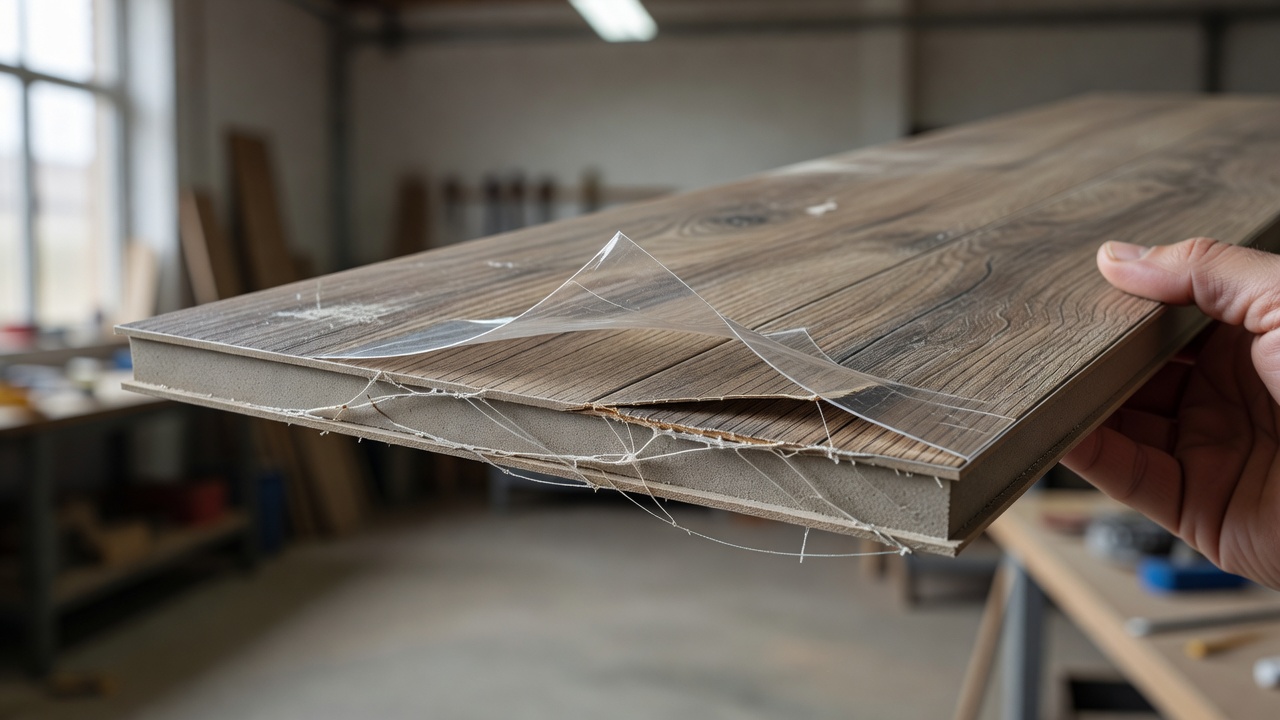
Delamination is when layers that were supposed to stay married decide they prefer separate lives. In LVP the usual suspects are moisture-driven interfacial shear, adhesive plasticizer migration, and thermal cycling that repeatedly stresses the bond line.
Here’s the numbered sequence of what’s actually happening at the bond:
- Water vapor or liquid reaches the core or the underside of the wear-layer/décor stack (edge wicking, wet mopping, subfloor moisture).
- The affected layers respond differently to moisture or temperature while constrained.
- Differential expansion creates shear stress right at the adhesive or thermal-lamination interface.
- Once micro-cracks form, every subsequent wet/dry or hot/cold cycle pries them farther open until you see edge lift, bubbling, or full sheet peel.
Why does engineered hardwood cup or delaminate?
Engineered hardwood fails by a related but woodier set of rules. The top veneer is anisotropic—it expands and contracts differently with grain direction and moisture content than the plywood or HDF core beneath it. When the room’s vapor pressure changes faster than the core can equilibrate, you get cupping (edges high, center low) or crowning (the reverse). Keep that gradient long enough and the glue line between veneer and core sees repeated shear until it lets go—delamination.
Finish wear is a separate track: aluminum-oxide or urethane topcoats abrade first, then the wood fibers themselves fuzz and gray. Once the finish is breached, liquid water can drive straight into the veneer and the cupping accelerates. That’s why a water spill that sits overnight on a worn engineered floor is so much more dramatic than the same spill on a fresh factory finish. The engineered hardwood cupping delamination mechanism is really just moisture gradient plus bond fatigue wearing the same path every time.
What happens when the wear layer wears through?
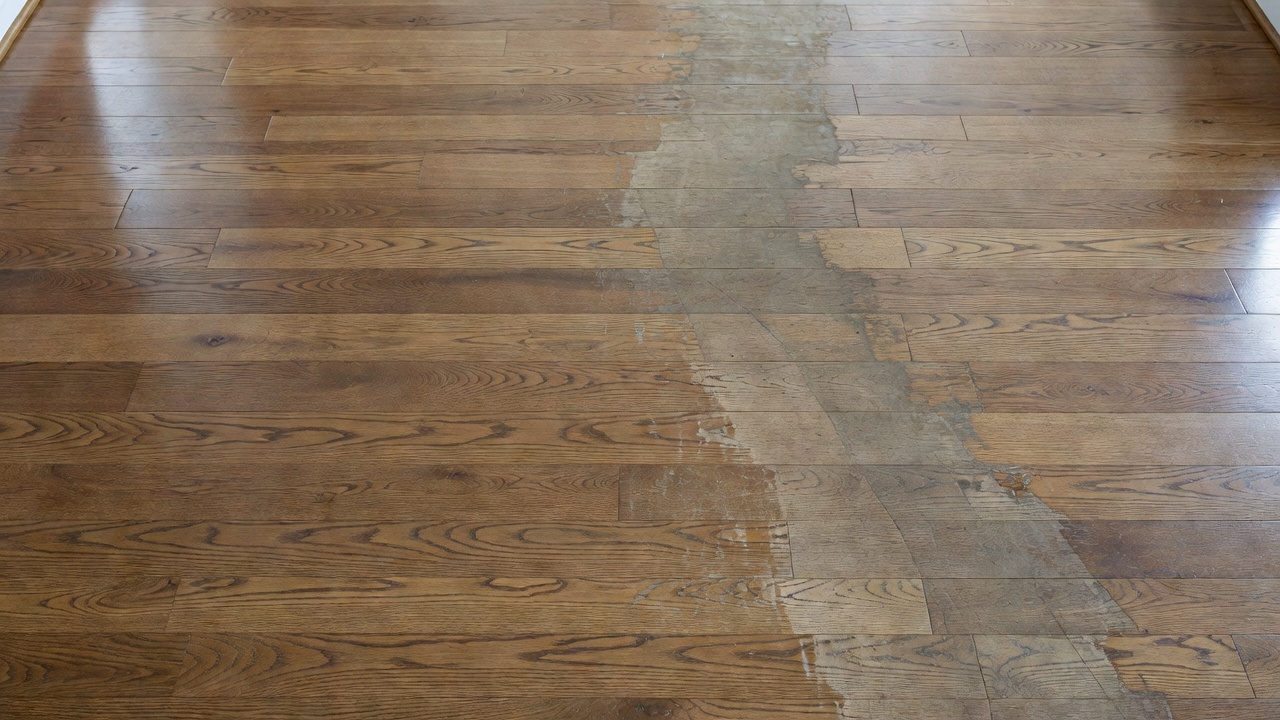
You see the décor layer or raw wood. In vinyl that means the printed film scuffs, colors dull, and eventually the pattern itself abrades into a pale, fuzzy track. In laminate the melamine overlay goes cloudy then white. In engineered hardwood you hit bare wood that will stain, gray, and collect dirt in the pores. Structurally the plank may still be fine—core intact, click joints holding—but cosmetically and hygienically it’s done. Dents are different: those are core compression (or wood cell collapse) from impact loads the wear layer was never meant to stop. Scratches live in the wear layer; dents live underneath it. Knowing which one you’re looking at tells you whether a refinish or a board swap is even on the table.
Abrasive wear depends on the contacting materials, load, grit and repeated movement. Outdoor mineral grit is especially important because it can turn ordinary foot traffic into repeated abrasion. That is why entry mats, sweeping and furniture pads remain useful even when the wear layer is thick.
Quick prevention checklist (because the science is only useful if you can act on it)
- Match wear-layer thickness and chemistry to actual grit and claw load, not just the showroom brochure.
- Test subfloor moisture with the method specified by the flooring and adhesive manufacturers; a handheld surface meter is not a substitute for an ASTM slab test.
- Leave the expansion gaps the manufacturer drew on the instruction sheet. They are not optional decoration.
- Felt pads, walk-off mats, and occasional refinishing (for wood) buy back years of service life the kinetics would otherwise steal.
FAQ
What causes delamination in vinyl plank flooring?
Moisture reaching the bond line between wear layer/décor film and core, combined with thermal or humidity cycling that shears the interface. Once micro-cracks open, peel propagates. Edge sealing and dry subfloors prevent most of it—less glamorous than a thicker wear layer, more effective.
How thick should a wear layer be for residential use?
Use the manufacturer’s intended-use classification, disclosed test method and warranty for LVP. For engineered wood, have the actual wear surface and construction reviewed before assuming it can be sanded. Thickness is one input, not a performance guarantee.
Why does engineered hardwood cup or delaminate?
Moisture gradients make the top veneer expand or shrink differently from the core, creating shear at the glue line. Prolonged cupping plus finish wear lets liquid water in and finishes the job. Stable indoor humidity is the boring, correct fix.
What happens when the wear layer wears through?
The decorative layer or bare wood is exposed, looks permanently dull or fuzzy, and can no longer be cleaned or protected the same way. The core may still be sound, but the floor’s intended appearance and cleanability are gone.
Are scratches and dents the same failure mode?
No. Scratches remove or groove the wear layer; dents compress the core or wood cells beneath an intact or partially intact wear layer. One is surface abrasion kinetics; the other is yield strength of the substrate.
Sources & standards
- NWFA Installation Guidelines — wood-floor site conditions, subfloors, moisture and installation.
- USDA Forest Products Laboratory Wood Handbook — wood structure, moisture behavior and dimensional change.
- ASTM F2170 and ASTM F710 — concrete relative-humidity testing and resilient-floor substrate preparation.
- ASTM D4060 — what Taber abrasion testing measures and why coatings cannot be compared on thickness alone.
Checked August 30, 2026. Product instructions and local conditions control whenever they are more specific.