what floor is best for my project
Flooring Durability Ratings: AC, Wear Layers and Janka Explained
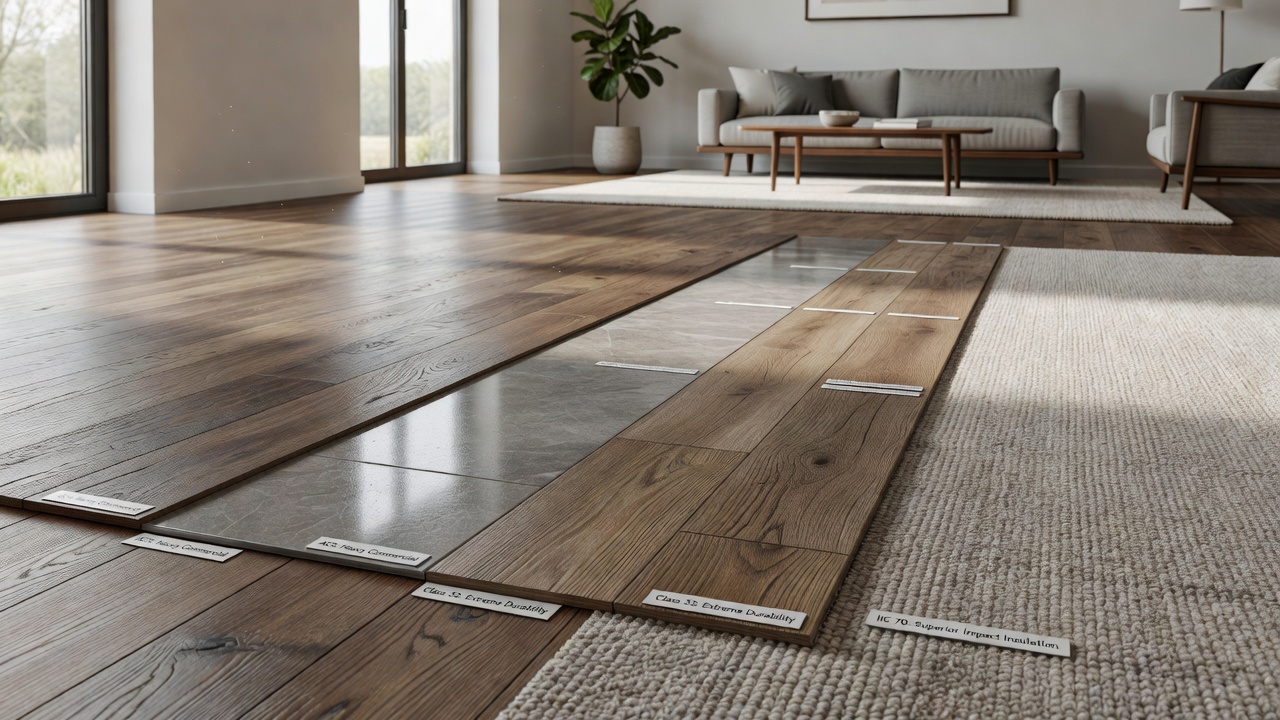
Flooring durability ratings are useful only when the test, product family and failure mode are named. An abrasion classification for laminate, a declared wear-layer thickness for vinyl and a hardness value for wood do not sit on one universal scale. Each describes a different part of a different system.
The practical goal is not to find the largest number. It is to identify what could damage the floor in a particular room, then look for evidence that addresses that failure. The exact product’s current installation instructions, warranty and maintenance guide remain part of that evidence.
Use a rating-to-failure decision method
Start with the room rather than the carton. Write down the four or five conditions most likely to matter: tracked grit, dog claws, chair casters, dropped cookware, standing water, direct sun, rolling loads or indentation from narrow furniture feet. Then translate each condition into a possible failure.
| Room condition | Likely failure to investigate | Evidence worth requesting |
|---|---|---|
| Grit at an entry | Surface abrasion and visible dulling | Applicable surface test, care instructions and entry-mat plan |
| Rolling desk chair | Joint stress, finish wear or indentation | Rolling-load guidance, chair-mat rules and substrate requirements |
| Dog traffic | Visible scratches, soil and occasional spills | Finish information, cleaning limits and a full-size sample |
| Heavy furniture | Local indentation or constrained floating floor | Load restrictions, protector guidance and installation instructions |
| Kitchen or mudroom | Spills, edge exposure and dropped objects | Water-claim conditions, seam details and repair procedure |
This method prevents a common category error: asking an abrasion number to predict indentation, or asking a wood-hardness value to predict finish scratches. The high-traffic failure-mode guide goes deeper on matching household hazards to material systems.
AC classification and wear-layer thickness are not interchangeable
NALFA describes LF-01 as an ANSI-accredited laminate performance standard with multiple durability and quality evaluations. AC shorthand belongs in that laminate context; it should not be stretched into a universal ranking for every material. Even within laminate, confirm that a claim applies to the exact collection and determine whether it is a certification, a declared test result or marketing language.
A vinyl wear-layer figure describes the declared thickness of a protective portion of the product. One mil is one thousandth of an inch; it is not one millimeter. The figure can help compare closely related products, but it does not independently describe coating chemistry, locking-joint strength, dimensional behavior, pattern realism or repairability.
ASTM F3261, the specification for modular resilient flooring with a rigid polymeric core, treats rigid-core flooring as a complete construction with physical and performance requirements. That is a better mental model than turning one layer into the entire quality score. Use the wear-layer science guide to separate surface coating, wear layer, core and attached backing when two product sheets use different units.
Janka hardness answers a narrower wood question
Wood hardness data can compare resistance to a standardized indentation method, but hardness is not a promise that an installed wood floor will resist every dent or scratch. The USDA Forest Service Wood Handbook emphasizes that wood properties vary and that moisture and service conditions affect performance. Species is therefore one input, not a complete flooring specification.
For a wood floor, also examine construction, grade, board width, finish, maintenance pathway, substrate, site conditions and repair options. A harder species can still show surface scratches. A softer species may remain serviceable when its appearance, finish and repair plan fit the household. Engineered wood adds another variable: the wear surface and core construction must be evaluated on the exact product rather than inferred from the species name.
The useful buying question is not “Which species wins?” It is “Which visible change would bother us, and can this floor be maintained or repaired when that change occurs?” The hardwood and engineered-wood guide provides that broader construction and service-life comparison.
Check the evidence before paying for a bigger number
A durability claim deserves five checks:
- Name the standard or method. “Commercial grade” without a checkable basis is positioning, not evidence.
- Match the exact SKU. A brand-level statement may not apply to every collection, color or construction.
- Read the scope. Determine whether the result addresses abrasion, indentation, impact, water exposure, joint strength or something else.
- Read the exclusions. Rolling loads, pets, sunlight, wet areas, rubber-backed mats or steam cleaning may be handled separately.
- Inspect a representative sample. Use several full planks if possible. View the surface in the actual room, join sample pieces where permitted and test only manufacturer-approved cleaning methods.
Stop the purchase when a seller cannot identify the exact product behind a rating, when two documents conflict, or when the warranty requires site conditions nobody has planned to measure. A bigger headline number cannot compensate for an unsuitable substrate or an unapproved installation method.
FAQ
Is a higher durability number always better?
No. A higher result may be useful within the same test and comparable product family, but it may address the wrong failure for the room. Compare like with like, then evaluate installation and maintenance requirements.
What is the difference between AC classification and vinyl wear-layer thickness?
AC is laminate performance shorthand associated with an abrasion classification. Wear-layer thickness is a physical dimension used on resilient products. They describe different systems and should not be converted into each other.
Does a thicker vinyl wear layer prevent dents?
Not by itself. Indentation can involve the whole plank construction, the support below it and the load’s contact area. Check the exact product’s indentation or rolling-load information and furniture-protection guidance.
Does Janka hardness tell me whether a wood finish will scratch?
No. It provides hardness information about wood, while visible scratching also depends on the finish, grit, contact shape, lighting and maintenance. Request finish-specific documentation and keep expectations tied to the complete floor.
Sources & standards
- NALFA product certification standards — LF-01 laminate certification context and performance framework.
- ASTM F3261: rigid polymeric-core resilient flooring — scope and performance requirements for rigid-core resilient flooring.
- USDA Forest Service Wood Handbook — primary reference on wood properties, moisture and mechanical behavior.
These sources define tests and material behavior; they do not rank a specific retail product. Current manufacturer documents for the exact SKU control the final product and installation decision.