How to Prep Subfloor for Hardwood Flooring: Pro Guide
 Last Tuesday I'm on my knees in a 1960s ranch over in Maplewood, gas-station coffee gone cold in the cup holder, and the homeowner's still talking about "just laying it down" because the old subfloor "looks fine." It didn't. Preparing a subfloor for hardwood flooring means making that structural layer clean, flat to within 3/16 inch over 10 feet, dry to the manufacturer's moisture numbers, and solid enough that nothing moves when you walk. Subfloor preparation is the grunt work of getting the layer under your finish floor ready so the hardwood doesn't cup, squeak, gap, or void the warranty inside two years. Skip it and you're paying me twice.
I charged him for the prep day he didn't want. He paid. The floor will last. That's the whole game.
How flat does a subfloor need to be for hardwood flooring?
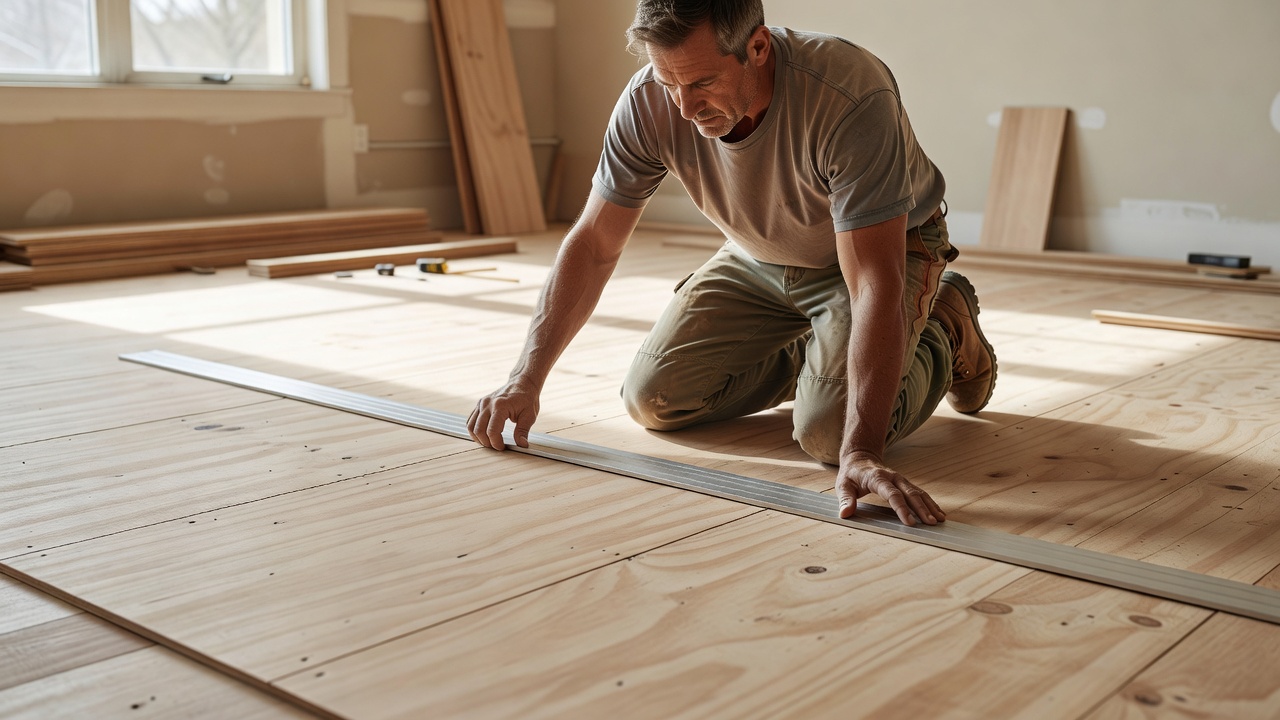
Most manufacturers write it plain: no more than 3/16 inch deviation in 10 feet, or 1/8 inch in 6 feet for some of the pickier engineered lines. I carry a 10-foot straightedge and a stack of feeler gauges because eyes lie and phone apps are a joke under jobsite lights. High spots get sanded or planed. Low spots get filled with a cementitious leveler rated for wood subfloors—not the bag of floor patch somebody bought because it was on sale next to the paint.
I once watched a crew "float" a 3/8-inch belly with loose underlayment foam because the designer wanted the wide-plank look installed that afternoon for a photoshoot. Six months later the boards were telegraphing every dip like a topographical map. Wide planks and fancy patterns do not forgive a bad substrate. They advertise it. If your floor has that soft spot near the fridge or the dip where the old laundry hookup used to live, you fix it before a single board goes down. [LINK: leveling uneven subfloor] is not optional busywork. It is the difference between a floor that stays quiet and one that sings every time the dog walks across it.
Particle board is not a subfloor for hardwood. I will say that again for the people in the back who found a "money-saving tip" online. Particle board under hardwood is a failure waiting on humidity. It swells, it crumbles around fasteners, and no reputable manufacturer will warranty over it. Tear it out or sister proper plywood over it if the structure allows. OSB can work if it is the right grade, properly acclimated, and fastened to hell and back, but I still prefer plywood.
What is the best subfloor material for hardwood?
Plywood. APA-rated plywood, 3/4-inch minimum for joists on 16-inch centers, exterior glue, smooth face up. That is the best subfloor for hardwood in a wood-frame house. I have installed over good 23/32 OSB when the schedule and the budget forced it, and it held when the moisture numbers were right and the fastening schedule was followed. But plywood is more dimensionally stable, takes fasteners cleaner, and does not have that edge-swell habit OSB shows when a plumber drips on it for three days.
Concrete slabs are their own animal—different moisture tests, different vapor barriers, different leveling compounds. This piece is about wood subfloors because that is what most of the callbacks and the "my floor failed" stories come from. If you are over a slab, get the relative humidity numbers with in-situ probes before you even order the wood. [LINK: hardwood over concrete moisture barrier] is a separate headache and worth its own day.
Older homes love to hide surprises. I have pulled carpet and found 1/2-inch plywood over skip-sheathing, or three layers of vinyl over boards that were never meant to carry a nail-down floor. You do not install hardwood over mystery sandwiches. You investigate, you add thickness where the span rating demands it, and you make sure the whole assembly can hold a fastener.
How do you test subfloor moisture before installing flooring?
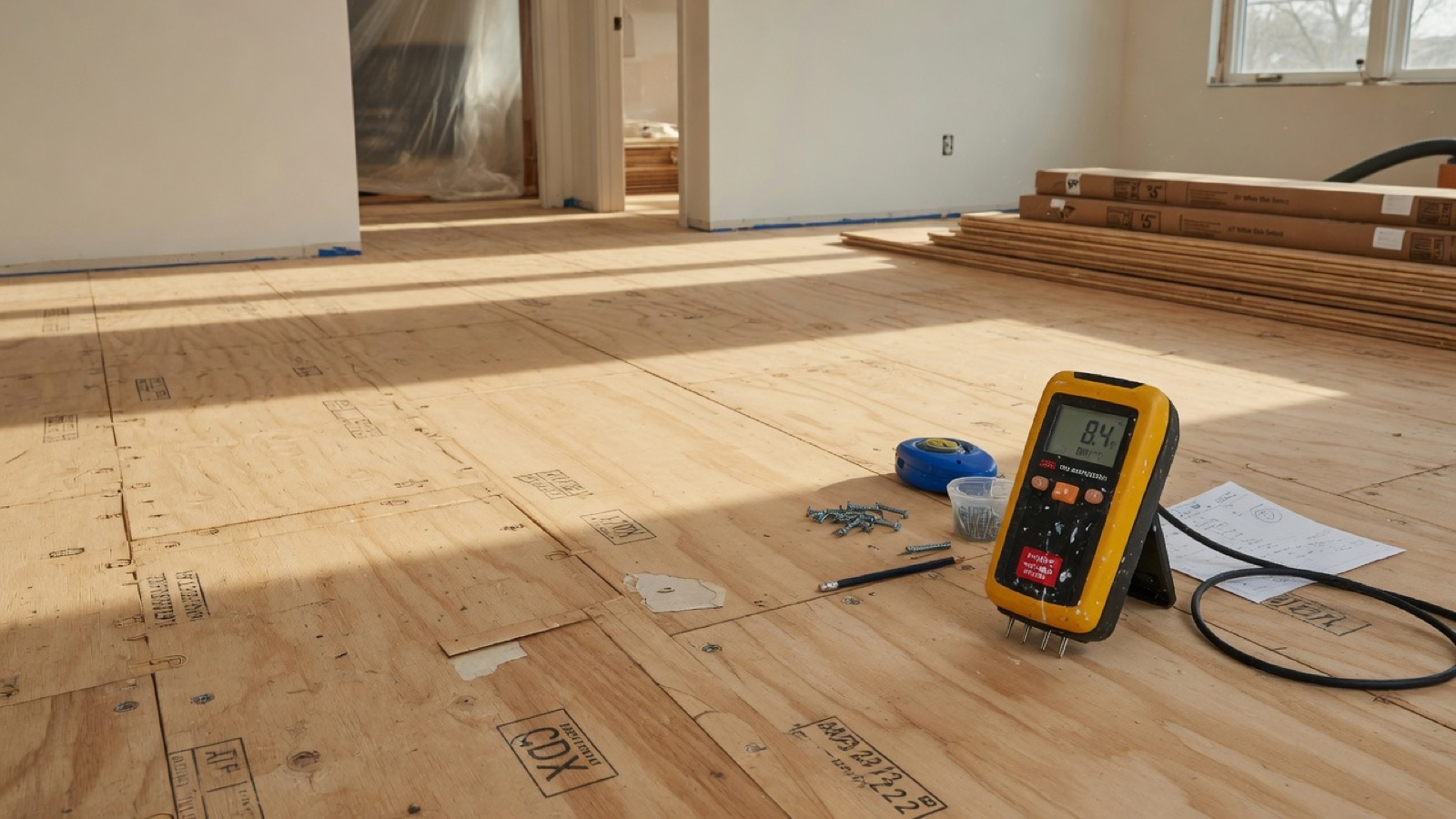
You test it with a proper meter, not your palm and a hopeful shrug. Pin or pinless meter calibrated for the material, multiple spots across the room, and you write the numbers down. Wood subfloor should generally sit under 12 percent moisture content and within 2 to 4 percentage points of the hardwood you are about to install—check the specific manufacturer sheet because some are tighter. Then you wait. Acclimation is not a suggestion printed on the side of the box for lawyers. It is physics.
Here is the part that still makes my knee ache just remembering it. Moisture testing is 80 percent of why floors fail and maybe 5 percent of what homeowners want to pay for. I got called to a new build in '09—nice couple, two kids, white oak they picked because it looked "organic" in the showroom lighting. Builder had poured the basement slab, framed, and decked the first floor with OSB during a wet spring. Nobody ran a meter. They hung drywall, painted, and the flooring crew showed up and nailed 3/1/4 solid right down. Looked perfect at walkthrough. Eight months later the heating season kicked in, the OSB finally dried, and the oak cupped hard enough you could catch a sock on the edges. Whole main floor. They had trapped construction moisture under a vapor-retarding underlayment like a sandwich, and the wood had nowhere to go but up. Insurance fought it. Manufacturer voided the warranty because no moisture readings existed. I spent three weeks demoing and reinstalling while the family lived in the basement. The husband kept asking why nobody "just knew." Because nobody tested. Because the schedule said flooring week. Because the floor "looked fine" when the light hit it from the window. I still carry photos of that cupping on my phone. Not for fun. For the next guy who tells me the meter is a waste of an hour.
Never install over a subfloor you have not metered in multiple places on the same day you start. If the numbers are high, you run dehumidifiers, you wait, you retest. You do not "get it done before the holiday."
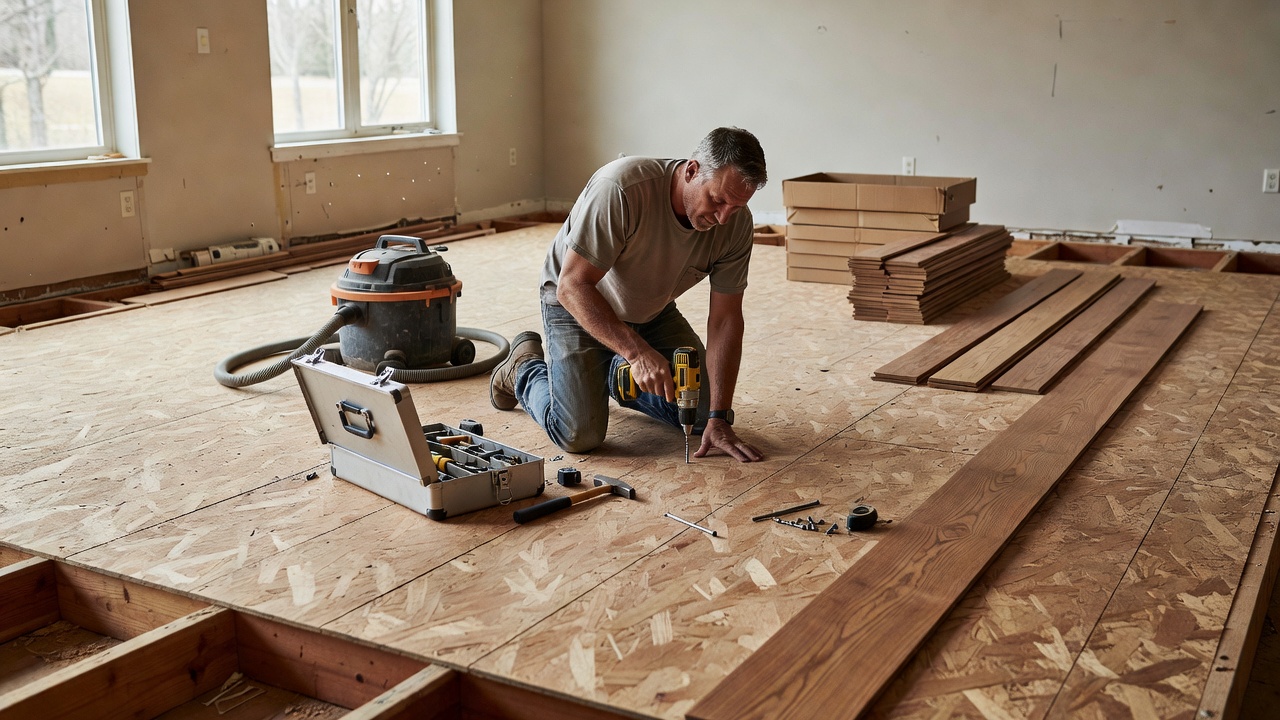
Clean means broom, vacuum, and scraper. No drywall mud chunks, no staple mountains from the old carpet, no pet hair felted into the corners. Those little ridges become telegraph lines under thin wear layers. Fasteners get walked down or pulled. Squeaks get screws into the joists before the new floor covers the evidence—find the joists, hit them on both sides of the squeak, and move on. I use a chalk line and a screw gun, not hope.
Can you install hardwood flooring over OSB or particle board?
OSB: sometimes, if it is rated, flat, dry, and fastened correctly. Particle board: no. I have already said it. Particle board turns to oatmeal with a modest moisture bump and does not hold nails or staples for the long haul. If your existing layer is particle board, budget for removal or a proper plywood overlay that meets thickness and span requirements. Same goes for those old lightweight concrete patches and the mystery underlayments from the '90s. If you cannot identify it, do not trust it.
One numbered list. That is all you get from me:
- Meter the moisture and write it down.
- Check flatness with a real straightedge and mark highs and lows.
- Fix structure and squeaks first—screws into joists, sistering if needed.
- Level or sand to tolerance.
- Final clean, final meter check, then and only then bring the hardwood in to acclimate.
Anything marketed as a "floating solution for imperfect subfloors" is usually a way to sell you a product that still fails when the substrate moves. I have pulled enough of those to know. Trends come and go. Physics does not.
FAQ
How flat does a subfloor need to be for hardwood flooring?
Most specs call for 3/16 inch or less in 10 feet, sometimes 1/8 inch in 6 feet. Measure with a straightedge, sand the highs, level the lows, and do not guess.
What is the best subfloor material for hardwood?
APA-rated plywood, 3/4-inch for standard joist spacing, is the most reliable. Proper OSB can work; particle board does not.
Can you install hardwood flooring over OSB or particle board?
OSB yes if it meets grade, flatness, and moisture rules. Particle board no—remove it or overlay with plywood.
How do you test subfloor moisture before installing flooring?
Use a calibrated moisture meter on the subfloor in multiple spots. Readings should meet the hardwood manufacturer's limits and be close to the flooring's own moisture content before you start.
Do I need a vapor barrier over a wood subfloor?
Only if the manufacturer requires it or you have a known moisture source below. Blindly adding the wrong retarder can trap moisture and create the sandwich I still have nightmares about.
Anyway. Call somebody before you rip anything out. Doesn't have to be me. Should probably be me.