Columbia Click Floor Buckling/Warping
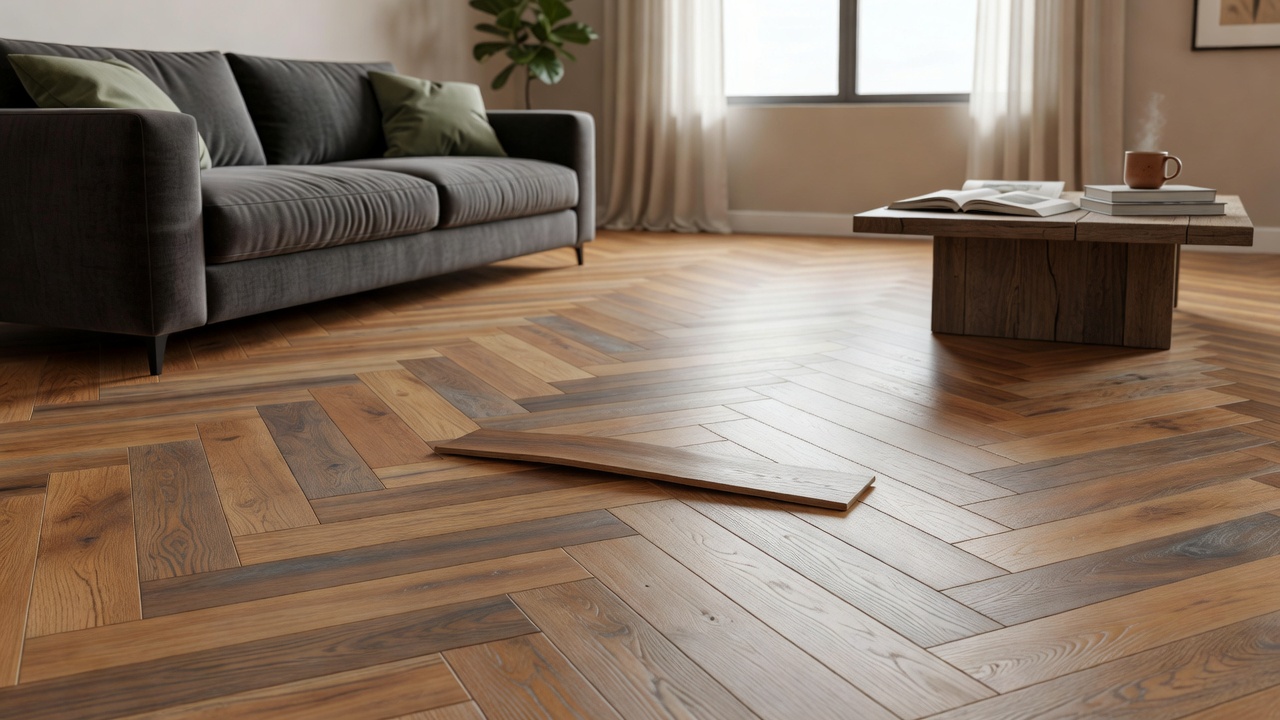
Q: Help! About 7 years ago my wife and I installed Columbia Click flooring in our Condo. IT has been great – up until about two weeks ago. In our dining area, which is about 100sq ft in size, right about in the middle it started to buckle and warp upwards.
There are no water pipes or anything of that nature in the dining area, and we haven’t spilled anything on it. Only two things in the house have changed but I can’t imagine this is it:
1. We had air conditioning installed last year and also started using forced air heat to warm our condo in the winter (we live in San Diego and frankly never used the heater until we upgraded to whole HVAC system). We have one output vent in the dinign area, but not near where it is buckling. We haven’t even really used the A/C this year. Could the heat/ac combination have caused this? The floor now expands and contracts more often than it did before????
2. We have a three year old daughter. Last year we bought her a small play kitchen. It is the only other thing in the dining room besides the dining room table. It weighs about 45 pounds. It is up against one of the walls. Could it be causing the floor to not float as freely?
Finally – how do we stop it and/or repair it without redoing the entire dining area? The warp is now about 1/4′ inch high. Enough to notice while walking thru and even catching a foot on when walking by.
We do have some planks left over from the initial install, but I would even want to try cutting out and repairing the warped area without understanding the cause first.
I did some follow up to get a bit more information on the room and a few pictures:
Follow-up: Did the best I could on pics and I hope this gives you a good idea. Attached are 3 pics:
‘wide view – shoes as reference for warp and vent location.jpg’ – This pic shows a wider angle of the dining area. The pink (awesome) shoes show how wide the warping area is. You can also see where the vent is located for HVAC. I don’t know the exact path of the vent. Only that it is underneath the dining room floor. From the vent – it drops down about 4 inches and heads in the same direction of the line I drew. From there I don’t know if it angles slightly and heads straight underneath the warp or not. Maybe condensation going up, and causing the subfloor to warp and push up on the floating floor? Distance between shoes is about 18 inches. The HVA unit is downstairs in the direction of the line. I just don’t know if it is a straight shot, or if it has to angle to get there.
‘ruler at angle.jpg’ gives you a sense of how far up the floor has pushed. About 2mm. Pic isn’t great, but you can see the ruler is flush on the fllor on the left, but raised up on the right where the floor is lifting.
‘over hang.jpg’ – this shows that to one side of the dining area is an overhang. On that side of the room the floor has plenty of room to expand. The decorative wood covering I have on there is fairly superficial. If the floor expanded in that direction it would push out the covering instead of giving in and buckling up.
Regarding the other 3 sides of the room and expansion gaps, I can tell you this. The side I am standing on when taking the pic is where my daughters play kitchen is. I pulled off that moulding easily and there is a half inch of expansion space. So that covers 2 of the 4 sides of the room.
Unfortunately the other two sides the moulding a nailed on pretty good and I didn’t want to wreck it. But from my memory I was super worried about that aspect when installing and left 1/2′ at least everywhere. If after reviewing the info on 2 sides of the room you think I should pull the moulding to be sure of the expansion gaps, let me know.
After looking at this myself, my theory is the HVAC vent routes underneath here and is causing condensation and the subfloor is warping. I just don’t know how to proof it. One thing that causes me to go against that theory is that the condensation should drop downwards and not upwards. I would also think that I’d get drips thru the drywall ceiling in the basement and I don’t see that. There is also one other room where the vent routes underneath the floor just like in the dining area and there are no problems in that room.
Anyway, open to ideas and how to start in fixing this. I have a horrible feeling of replacing the entire floor in the dining area.
– Steve
A: I had a chat with Gene D., iFLOOR’s commercial contract specialist to bounce a few ideas around. Our suggestion would be to first remove those last few base molds to make sure the expansion gap is in place. If the gap is gone, then removing the molding should establish some room and help your floor relax back into place.
If they are still there and the floor has not expanded to remove the entire gap, then you are more than likely looking at some moisture issue. I would suggest picking up a moisture meter from a local home store (should run you around $20-$25) and test the moisture content at the raised area versus an edge of the floor. If there is a difference, there is your culprit, if not, then its most likely an issue in your subfloor.
If this is the case, you could try weighing down that portion of the floor, sand bag or some such. You could also apply a bit of heat to the boards to help remove some moisture, then weigh it down with sand bags and it should relax the boards back down. One method of heating would be to wrap a steam iron with a towel, shoot a bit of hot steam into the towel and iron the boards, but use this as a last resort.