What Floor is Best for My Project?
Options to Floor Over Concrete
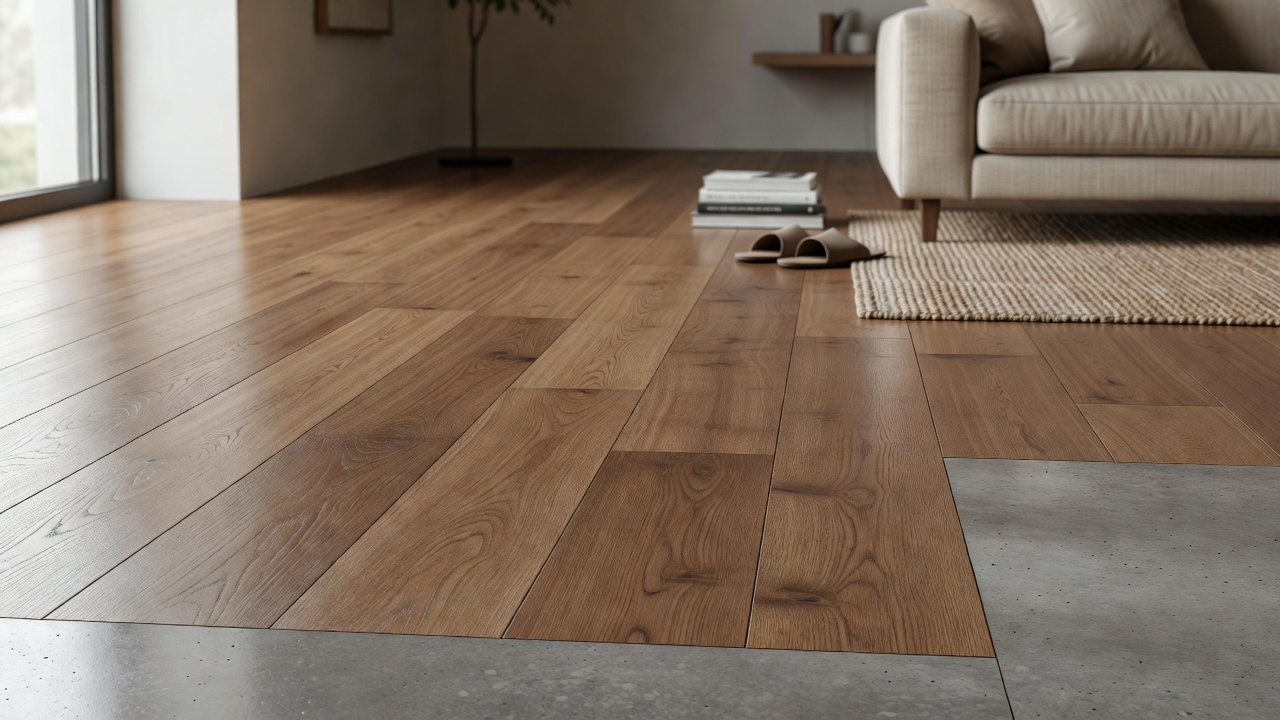
Q: I would like to know what is the best /least expensive option for a floor over concrete. I have a shop that is built on a floating slab of concrete. as you can imagine the floor is cold. We are turning a 14’x17′ part of it into a photo studio , that will also be used for dog obedience training once a week , so no carpet.
I would like to put some form of insulation over the concrete but I can only raise the floor 1 1/4 ” total. Can I use 1/2″ pink foam and 1/2″osb then glueless vinyl or self adhesive tiles. From what I read so far you can not glue VCT over OSB is this true ? I was hoping to avoid putting down $30 sheets over underlayment
Matt
A: My guess here is that you have a forced air heating system that will run in this room currently. If so, and assuming any spills will be cleaned promptly, you can look into a laminate floor. With floating wood floors like laminate, the floors typically will remain at room temperature even with how cold the concrete below may be. Now if you use cork as an underlayment, cork will insulate the floor a bit more and make sure the floor stays along room temperature even more.
If you are looking for something where moisture will not be an issue, such as if you expect a spill to happen when you won’t be able to quickly clean it up, I would personally suggest looking into tile or stone. Stone/tile is far more resilient all around than any other flooring out there, but your concerns about cold will need a bit of help to over come. Luckily this is an easy fix. Nowadays there are wonderful electric radiant heat systems which are built to go right into the thinset mortars used when installing stone or tile. One of the big names out there is Nuheat, which comes in both pre-sized mats and electric cable so you can account for oddly sized or custom floors.
I personally would avoid putting OSB over an insulation matting as the OSB will not be properly adhered to the subfloor and this can lead to a world of trouble in the future. The reason why is that as the OSB (or plywood) shifts, this shifting will telegraph through your floor and in the case of vinyl this movement can cause peeling.
The reason why OSB is not suggested for a VCT floor is that VCT must be glued into place. Due to its construction, OSB is not suitable for glue down applications, there are a few more expensive rated OSBs which can take adhesive, but even then it is not suggested for something like VCT and rarely will be suggested for any glue down application.