What is OSB?
Q: What is OSB?
Eric
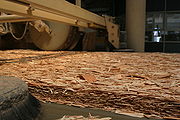
A: OSB stands for Oriented Strand Board. OSB evolved from Waferboard and is an engineered wood product formed by layering strands (flakes) of wood in specific orientations. In appearance it has a rough and variegated surface with the individual strips (around 2.5 by 15 cm or about 1 inch by 6 inches each) lying unevenly across each other in the direction of their grain.
It is manufactured in wide mats from cross-oriented layers of thin, rectangular wooden strips compressed and bonded together with wax and resin adhesives (95% wood, 5% wax and resin). The layers are created by shredding the wood into strips, these are sifted and then oriented on a belt or wire cauls. The mat is made in a forming line, the layers are built up with the external layers aligned in the panel direction and internal layers cross-oriented. This cross-orientation (similar to cross-play lamination used in making engineered hardwood) gives the board strength while also reducing the expansion and contraction that can occur from temperature change.
The sheet is then put through a thermal press to compress and cure the resin coating the flakes of wood, which causes the entire sheet to laminate together. Most of the worlds OSB is made in the USA and Canada in large production facilities. The largest production facilities can make over 1,000,000,000 square feet of OSB per year.
The difference between OSB and Plywood is fairly simple. Plywood is made of sheets of this wood laminated together rather than many flakes of wood. Both plywood and OSB are great subfloors for nail or staple down installations, but you should NOT glue down a floor to OSB.
Here is a great picture of what OSB looks like as it is being prepared for lamination.